
DermHair Clinic Los Angeles Advanced FUE Hair Restoration Clinic: Today’s hair transplant methods have undoubtedly evolved to impressive heights. It is now possible for patients to receive highly realistic and natural looking results. But this depends on the experience and skill set of the FUE hair restoration practitioner. Dr U uses the UGraft Advanced FUE to deliver consistent results in countless patients
Therefore, UGraft patients must be aware that these surgeries are not done through standardized processes that can be performed at any clinic. Each hair transplant case is extremely unique and requires a high level of specialized attention.
Dr. Umar’s extensive and world renowned track record of successful patient outcomes is due to his ability to identify the various subtle nuances and details needed to create outstanding coverage, aesthetics and wound healing for different levels of hair loss, repair and ethnic characteristics and other challenges. This not only translates to exquisitely refined surgical skills, but even the development of cutting edge, breakthrough hair restoration technologies. Dr U’s innovative works have been published in several esteemed Medical Journals
Hair Transplant At DermHair Clinic, Los Angeles
Follicular Unit Extraction or FUE involves the general use of micro-sized punches to harvest natural clusters of hair follicles. With this technique patients are able to avoid a permanent linear scar which would prevent them from choosing shorter, classic hair styles. But Most FUE procedures employ basic capabilities with limitations that include:
- Restricted to the use of only head hair as donors
- Inability to consistently extract tightly curled hairs
In recognizing these limitations of basic UGraft tools. Dr. U has developed the UGraft knife free minimally invasive hair transplant procedure that best basic FUE in the following ways:
- Enables the consistent extraction and utilization of beard, chest, leg and other body hair to add to the head donor pool leading an expansion of the total available donor supply
- Patients with severe baldness who wish to benefit from hair restoration surgery
- Hair repair cases where donor grafts have been exhausted from the head by prior surgeries
- Individuals of African descent who face high risk of transection due to curved shaped follicles
- Difficult FUE hair restoration cases where scalp tissue around the follicles is extremely dense.
Not only do Dr. U’s patented UGraft inventions protect the graft’s integrity for excellent yield, his punches are also able to render much higher wound healing results, compared to average FUE instruments.
Hair Restoration Surgery
DermHair Clinic Los Angeles Advanced FUE Hair Restoration Clinic: The extraction of follicle grafts constitutes just one phase in a hair restoration surgery. But during the insertion phase, there are many factors that need to be considered for producing the best aesthetic results possible. These include:
- Hairline and temple design
- Density
- Slit creation parameters like angle and direction
Dr. U carefully studies the individual’s facial traits of each patient as a prioritized part of the hair transplant planning process to ensure the most flattering and natural looking outcome. We invite you to view our video and photo galleries.
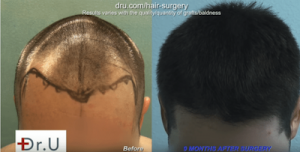 Expanding the donor area. Expanding the possibilities. The severely bald were poor candidates until Dr. Umar started a non-tradition. In his care, you can say goodbye to the days of baldness and disfiguring scars and say hello to a lasting aesthetic design you would normally expect from nature. His innovative excision techniques that exploit non-traditional donor hair where necessary have transformed the lives of his patients in ways many believed to be impossible. The future of hair transplant surgery has indeed arrived.
Dr. Umar at DermHair Clinic Los Angeles Advanced FUE Hair Restoration Clinic is widely recognized as the best hair restoration surgeon in the world for reversing severe baldness.
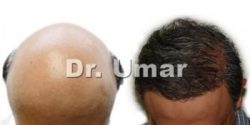
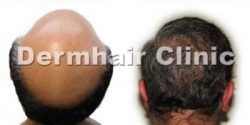
And he is known as the best doctor in the world for hair transplant repair.
Publications
Dr. Umar are recommended from these websites