Hair Loss

Men aren’t the only ones who lose their hair. American Health Journal has acknowledged that upwards of 21 million women in the United States are suffering hair loss, and this article in Women’s Day reveals that 50% of women will experience some hair loss by the age of 50. While it doesn’t manifest in the [...]

Read more >>

Online news source Health Day interviewed Dr. Umar regarding a new frontier on hair loss research. Recent genetic analysis of scalp tissue has shown a strong link between the protein PGD2 and hair loss. PGD2 is a prostaglandin needed for various functions of the body to run smoothly. However, when found near stem cells in [...]

Read more >>

What is Alopecia Totalis?

April 19, 2011

What if you experienced complete hair loss in just one week? Alopecia totalis is a rare condition in which the sufferer experiences complete hair loss of the scalp. And it can happen quite rapidly. In some cases of alopecia totalis, even the eyelashes and eyebrows may be lost. It is one of three types of [...]

Read more >>

Your eyebrow hairs grow from the follicle at a sharp angle, so, unlike the hairs on your head, your eyebrow hair is growing flat against the surface of your skin. The growth cycle of your eyebrow hair is also far shorter than that of the hairs of your scalp – about four months, as compared [...]

Read more >>

Men’s Hair Loss Studies

March 26, 2011

Studies show that the average time lapse between discovery of hair loss and finding treatment is six years.  As hair loss gradually worsens, the sufferer goes from sad denial to hope that it’s a temporary condition and the hair will grow back. However, it is simple to look at your own family tree; the hair [...]

Read more >>

Hair transplantation is one of the most popular, successful and innovative procedures today, but not many know the history behind the revolutionary procedure that has helped countless of individuals. Hair loss due to disease, scarring and androgenetic alopecia has troubled individuals since the beginning of time. The first attempts at surgical hair restoration of hair [...]

Read more >>

Strip surgery is one of the most ineffective ways to restore hair loss. It involves strip mining hair from the sides and the back of the head for transplant to the problem area, but it leaves scarring and lasting pain in its wake. Too, it often leaves you in need of more surgery when the [...]

Read more >>

Several studies on hair loss have shown that the general time between initially noticing hair loss and seeking treatment is about six years. This is definitely more understandable because of the fact that hair loss is on average a gradual process. There is almost always that sad denial stage,and then the phase that patients hope [...]

Read more >>

Hair Loss Studies

February 9, 2011

Many studies done on hair loss show that the general time between initially noticing losing hair and seeking treatment for hair restoration is about six years. This makes perfect sense considering that most hair loss happens gradually over time. An initial stage of sadness and denial is normal, followed by the hope that the hair [...]

Read more >>

A harsh hairline is common with the older strip method of hair transplantation because it uses hair from the middle and back of your head, which is thickest. This patient has had a good quality hair transplant from a top clinic specializing in the older strip method, but wanted a softer hairline. Dr. Umar used [...]

Read more >>

This is a very sensitive subject and a hard choice to make, which is one of the reasons you will get an array of answers, depending on who you ask. I feel the simplest and most sound decision for a surgeon to make is not to offer treatment to a young patient, period. While many [...]

Read more >>

Contrary to public belief, ringworm has nothing to do with having worms, it’s a fungal infection. Think of it as a bad case of athlete’s foot. It can break out anywhere on your body, and for many people a ringworm outbreak on the scalp contributes to hair loss because the fungus can cause your hair [...]

Read more >>

We lose hair all the time through everyday, necessary activities such as washing, combing and brushing our hair. Most people have about 100,000 hair follicles, with different levels of density depending on your background. It is normal to lose hair at a rate of about 100 strands a day. If you notice anything more than [...]

Read more >>

Black Women and Alopecia

November 10, 2010

Alopecia is a form of baldness that can affect all people, but some forms uniquely impact black women. Traction Alopecia is caused by continual pulling of the hair from tight braids, ponytails, and weaves. Over the years, bald spots can form along your hairline and above your ears, and your hairline will steadily recede. If [...]

Read more >>

This patient’s severe baldness was exacerbated by bad transplants and several failed restoration surgeries done elsewhere. The aftermath: Several large widened strip scars that wrapped around his head. Scars in the crown and front from an attempt to suture a wig permanently to his head. Poorly angled large plugs consisting of five- to six-hairs. Severe [...]

Read more >>

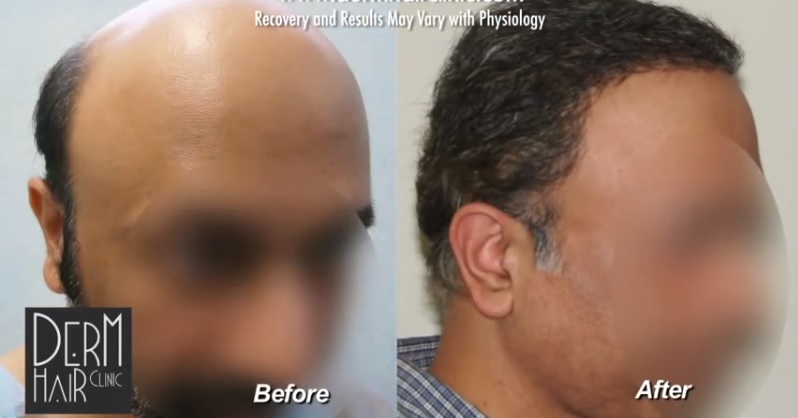
This patient’s crown hair and hairline was restored with 1,500 grafts transplanted from one part of his head to another through the minimally invasive approach of Follicular Unit Extraction. Among benefits enjoyed, he can now cut his hair as short as he likes because there is little scarring, and he can swim and brave windy [...]

Read more >>

Though the technical procedure of Follicular Unit Extraction hair restoration is the same for all, there are some differences between ethnicities only an expert knows to take note of. Generally, Asian people have thicker hair follicles, which can result in the transplanted hairline ending up with a harsh, artificial look. But by using softer hair [...]

Read more >>

The patient in this video did not have enough donor hair on his head to meet the needs of repairing his severe hair loss and balding crown. Dr. Umar used a combination of hair from the patient’s head, body and beard (called body hair transplant) to transfer over 15,000 grafts to the damaged area. Nine [...]

Read more >>